Do aesthetic braces work as well as metal ones?
Barely a week goes by without someone asking me the same thing at a consultation: will aesthetic braces work as well as metal ones, or am I paying for the nicer look with a longer wait for my smile? I am always glad to hear it, because it means the person is thinking ahead instead of choosing blindly.
The short answer is yes, the effect is the same. Teeth move the same way, treatment takes the same time, and I do exactly the same work whether the braces are metal or sapphire. What is worth reading to the end is why that is true, and where the story that aesthetic braces supposedly “work slower” even comes from. Especially if you are currently torn between the two.
Teeth are not moved by the bracket, but by several things together
When I want to explain why the bracket material does not affect the result, I start with what actually moves teeth. And that is not the bracket. The bracket is just an anchor bonded to the tooth, and its only job is to hold the wire at a precisely defined angle. The wire does the work too: it is bent and tensioned so that it gently but continuously pushes the tooth in the right direction. At every check-up I inspect it, activate it or swap it for the next one in the sequence, and step by step we reach the goal.
What changes when I bond sapphire instead of metal?
Honestly, nothing in the plan. Both brackets carry the same tiny built-in values that dictate how much each tooth should tip and rotate, the same wires are used, the same elastics, the same chains. That is why I think of fixed braces treatment as a process led by the orthodontist, not as a product you pick by colour. The material chooses the look, the hand and the knowledge run the treatment.
Aesthetic braces still come in for check-ups, just like metal
The rhythm of treatment does not change because the braces are clear. We see each other every four to six weeks, at each check-up I look at how far the teeth have moved, activate the wire and add a few elements if needed. How fast the teeth move depends on your bone, your age and the complexity of the case, and not at all on whether the bracket shines or blends with the tooth.
When someone hears that a neighbour's child wore braces for eighteen months while they are already into their third year, the reason is almost never the colour of the brackets. Treatment length depends far more on regular visits, the orthodontist's dedication and cooperation than on which material you picked.
So where does the story that aesthetic braces are slower come from?
I will not lie and say the story was invented out of thin air. It has roots. It just refers to lower-quality ceramic brackets, not to what I use. Ordinary ceramic has more friction between the bracket and the wire, so the wire slides through it with more difficulty. On top of that it is more brittle and cracks more easily under force, so lighter forces are sometimes used on it to avoid breakage. Put those two together and, in a genuinely complex case, treatment can drag on by a month or two. That is the half-truth that then takes on a life of its own on forums.
Then why do I work with sapphire, not ordinary ceramic?
Because sapphire does not have those flaws. Sapphire brackets have a smooth surface and low friction, the wire slides through them almost like through metal, and they are roughly twice as resistant to fracture as classic ceramic. Everything that could slow treatment down with the cheap option simply does not exist with sapphire. That is exactly why I work only with quality sapphire braces: so that aesthetics never come at the expense of the result.
Will my clear brackets turn yellow?
This is the question I hear most from people who love their morning coffee, black tea or a glass of red wine, and from smokers. They worry that in a month those pretty clear brackets will go yellowish. The sapphire bracket itself will not. It is made of a crystal material that does not absorb colour, so it stays clear from the first day to the last.
What can occasionally pick up a tint are the tiny clear elastics that hold the wire. But I change those at every check-up anyway, so even that faint trace of colour is gone by the next visit. If you want to protect them between visits, it is best to steer clear of the same hard and sticky foods that cause trouble with braces in general.
So what is the difference, if the effect is the same?
The difference is exactly where you would expect it: in how noticeable the braces are. Metal shows, and for many people that is perfectly fine, kids even pick colourful elastics and enjoy it. Sapphire is discreet, it blends with the tooth colour and you can barely spot it in photos or in person. For adults who talk to people all day, or someone getting ready for a wedding, that can be the deciding factor.
The other difference is price, because sapphire as a material costs more than metal. Exactly how much is in the price list, and at the consultation we always weigh together what makes sense for your case and your budget. If you want to see how it looks once treatment is done, I regularly publish my patients' results, and both metal and sapphire cases are there, equally beautiful.
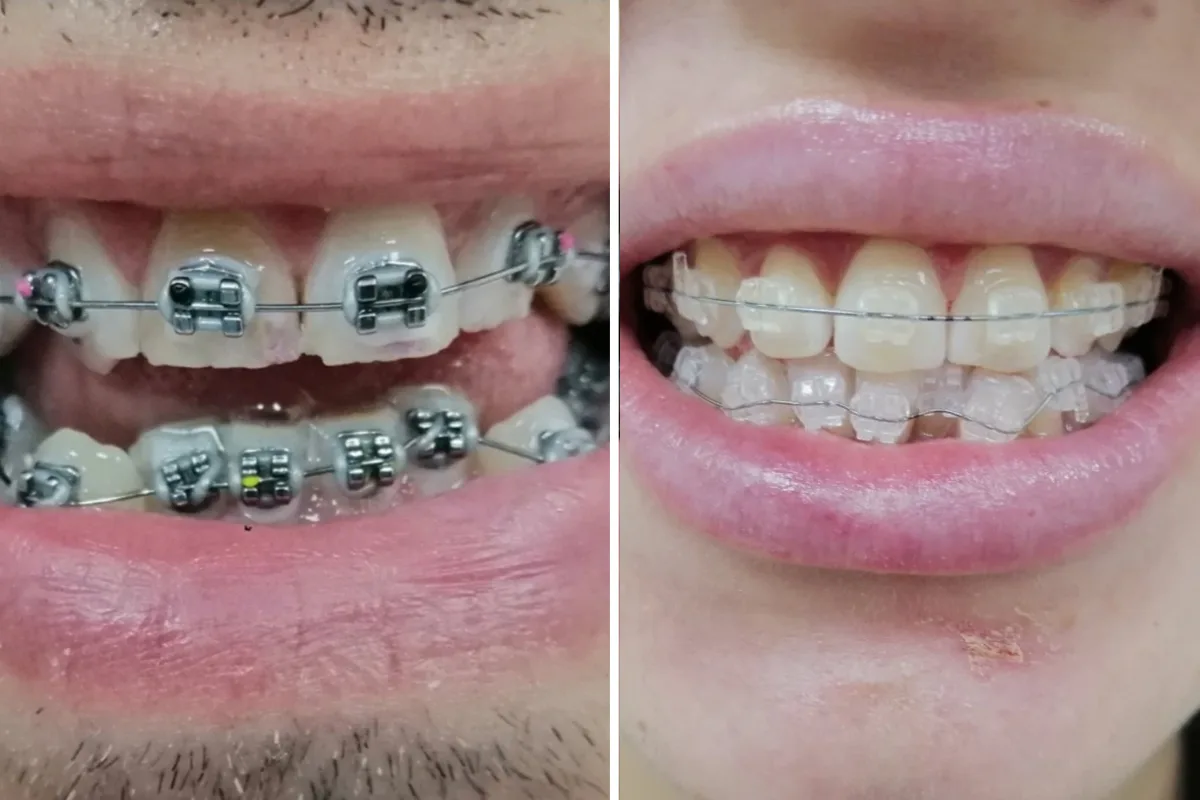
In the end, the decision is not medical but personal
If you take away one sentence from this whole text, let it be this: choose the braces by how visible you want them and what price suits you, not out of fear that the nicer ones will work worse. They will not. A great many of both have passed through my hands, and the smile at the end looks the same.
If you are still unsure, I am here to help. Come in for a consultation and we will look at your teeth, talk about what your day looks like, and choose together what genuinely fits you.
Got a question about this topic?
Book a specialist consultation or a free online consultation, I reply the same day.