How to Keep Your Teeth Clean With Braces
When I fit your fixed braces, you leave the clinic with a new feeling in your mouth, a little pressure on your teeth, and, to be honest, a bit more work ahead of you than yesterday. That is the part I like to talk through while you are still in the chair and not in a rush, because how you brush your teeth over the next year or two will determine how beautiful the smile is that you take home when I remove the braces.
One small thing before we start. Many of my patients come in and tell me they have had their dental prosthetics fitted, and I always smile a little because I know what they mean. Prosthetics replace missing teeth. Yours are all there, I am just moving them to where they belong. The right word is braces, and that is what I will use throughout. If it slips out, I will not mind, but you will understand why I smile.
Why hygiene matters more than ever now
Before braces, you had a smooth tooth surface and your toothbrush moved over it without obstacles. Now there is a small bracket bonded to each tooth, and a wire running through all of them. That is suddenly twenty or more new corners where food loves to get in and is very hard to get out with regular brushing.
Plaque, the soft film that builds up on teeth every day, starts settling right there, around the edges of the brackets and under the wire, in places you simply cannot reach with your normal brushing technique. If it stays there for days, three things happen that I really do not want to see at your next appointment.
The first is gum inflammation, or gingivitis. Gums that swell, turn dark red, and bleed when you brush. The second is tooth decay, which can cause real complications during treatment because I then need to remove the bracket, have the tooth filled, and refit the appliance. Your treatment runs longer for no good reason.
The third, and the one that concerns me most, is white spots on the enamel. These are the pale patches you see when someone gets their braces off after two years and finds pale rectangles left behind on each tooth, like little stamps. Those marks are permanent. Whitening, special toothpastes, and time will not remove them.
That is why I like to be clear about this from the start. Hygiene is not just something you should do. It is something that literally determines how your smile looks at the end. The good news is I am not asking for anything heroic. Just a few extra minutes, a couple of times a day, if you know exactly what you are doing.
What tools do you need for braces?
Your old toothbrush and toothpaste are now only half the story. Let's go through the tools I actually recommend, in the order you will use them.
Toothbrush basics
The one thing that is non-negotiable is soft bristles. Your braces are already putting force on your teeth. You do not need the additional pressure of hard bristles against your gums on top of that.
The interdental brush, the most important new tool
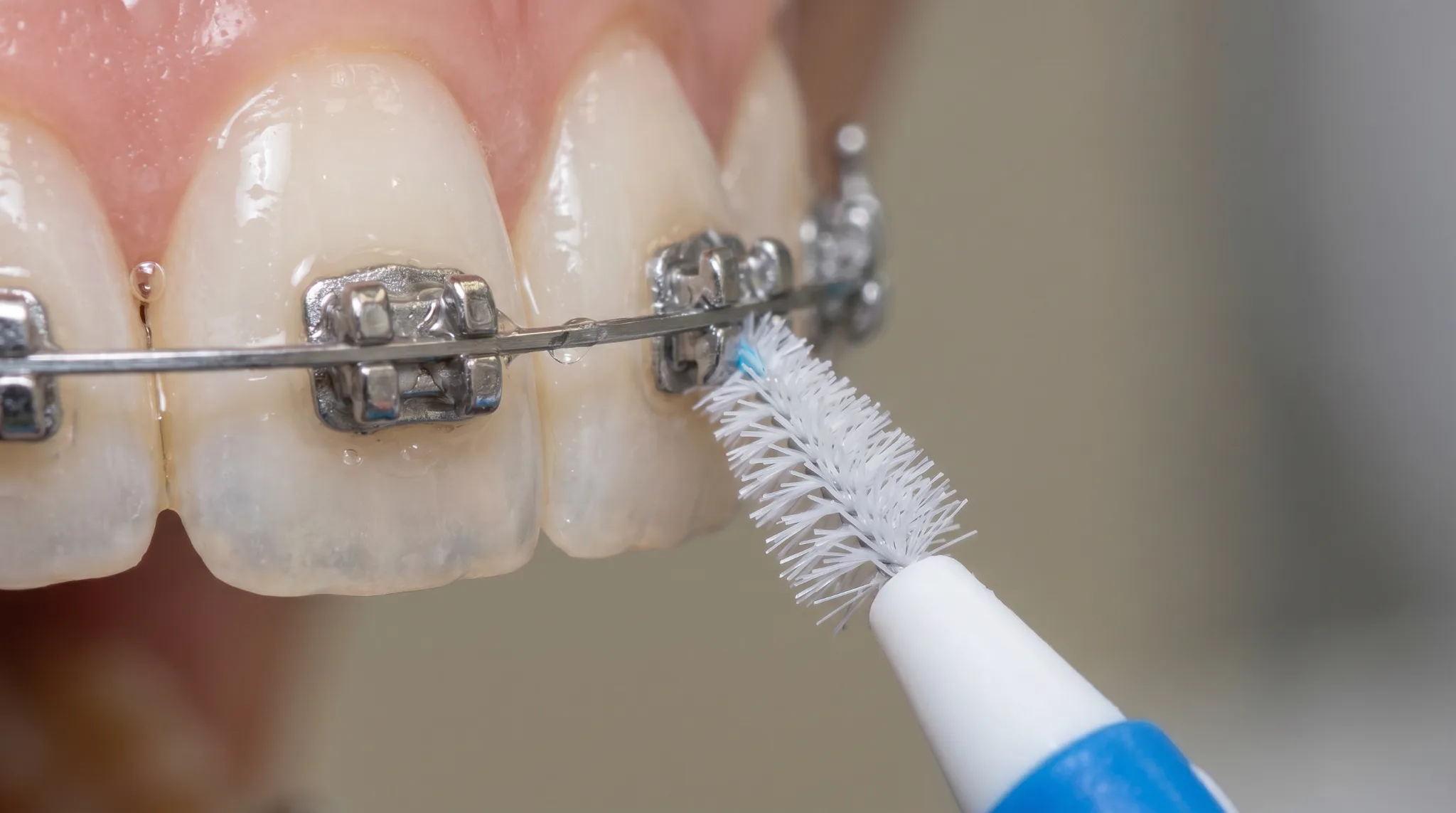
If I could give you one word to remember for the next year, it would be interdental brush. It looks like a tiny bottle brush, with a thin wire core and small bristles around it, and it gets into places a regular toothbrush cannot reach: between the bracket and the gum, around the wire, between two teeth.
You can find them in any pharmacy, in different sizes. At your first appointment I will show you which size is right for you, because too large will make your gums bleed and too small will not clean anything. It is handy to carry two sizes, one for the narrower spaces at the front and one for the wider spaces at the back. We will sort all that out together.
A water flosser, also known as a Waterpik, shoots a fine jet of pressurised water around the brackets and between the teeth. It is not a replacement for your toothbrush or the interdental brush, but it is a great addition, especially if you have a complex appliance or find detailed brushing difficult. My patients love it because it is quick and comfortable. If the budget allows, it is worth it. If not, do not worry, everything is manageable without it.
Toothpaste and mouthwash
Toothpaste does not play a decisive role. I personally prefer fluoride-free because the evidence shows that what causes tooth decay is how often and how well you brush, not what is in the toothpaste. Fluoride also has some known downsides for the body, so if we can avoid it, why not. Mouthwash is not essential either. My recommendation is to use one without alcohol, and not every day, because alcohol-based rinses can disturb the natural balance of your oral flora.
Brushing step by step, as if I am looking over your shoulder
This is the part I like to take slowly, because this is where the biggest difference is made between the patient who walks away after two years with a white, straight smile and the patient who walks away with a straight smile and white spots. Picture yourself in front of the mirror in the evening with everything laid out by the sink.
Toothbrush first, two full minutes
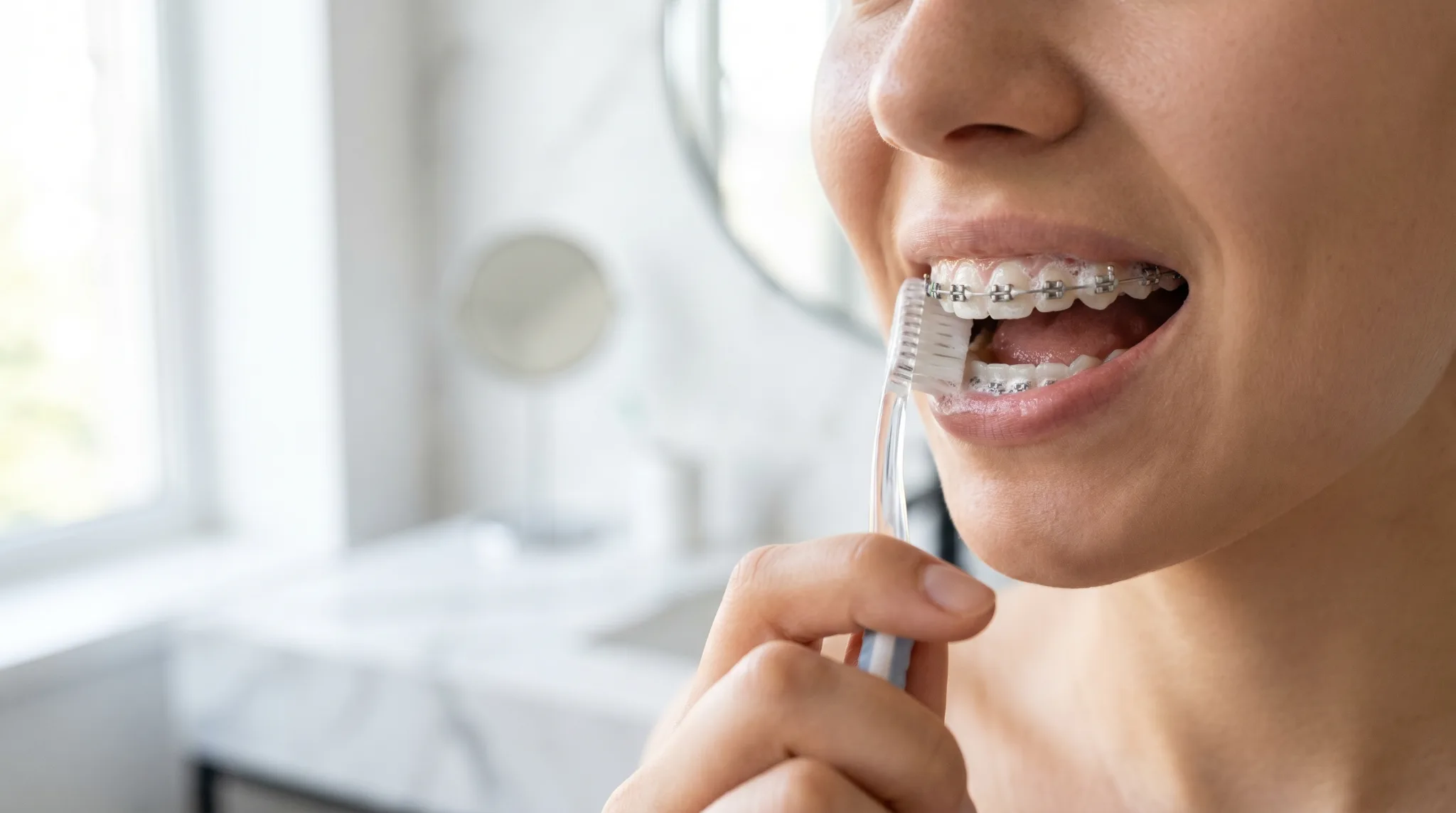
Put a small amount of toothpaste on your soft brush and work from one side of your mouth to the other, systematically, so you do not skip a single tooth. Hold the brush at roughly a 45-degree angle towards your gums, not straight on.
At each bracket, there is a small trick that most patients skip. First, tilt the brush downward toward the crown of the tooth and clean above the bracket. Then tilt it upward toward the gum and clean below the bracket. Most people brush across the side of the bracket and think they are done, but above and below it stays untouched, which is exactly where plaque loves to build up. Give each tooth a few careful circular strokes from above and below, then move on. Do not skip the inner surfaces or the chewing surfaces of the back teeth.
The whole thing should take two full minutes. If that sounds long, watch the clock the first time and you will be surprised how quickly you used to finish.
Interdental brush next, under the wire
Hold the brush by the handle and carefully slide it between two teeth, under the wire. This is where the common mistake is made. It goes under the wire, not over it. Move it back and forth two or three times to pick up everything in between, then pull it out and move to the next gap. Work through all the spaces in both rows.
Once you are in the routine, the whole thing takes under two minutes. Rinse the brush under water afterwards, and replace it when the bristles look worn, roughly once a week.
When I lay it all out like this it sounds like a lot of work, but once you have done it a few days in a row, the evening routine takes about six to eight minutes, and the morning one less. I think you would agree that is a small investment for what you are building.
The tricky part: hygiene when you are not at home
This is the part my patients are honest about only at the third or fourth appointment, when they realise it is not realistic to rush home and brush after every single meal. What do you do at work after lunch, at school after a snack, out at dinner? The truth is you will not always be able to do everything properly, but you cannot let hours go by without doing anything.
The simplest option is a vigorous water rinse for about twenty seconds right after eating. That alone removes a large portion of the food debris around the brackets. It is not brushing, but it is much, much better than nothing.
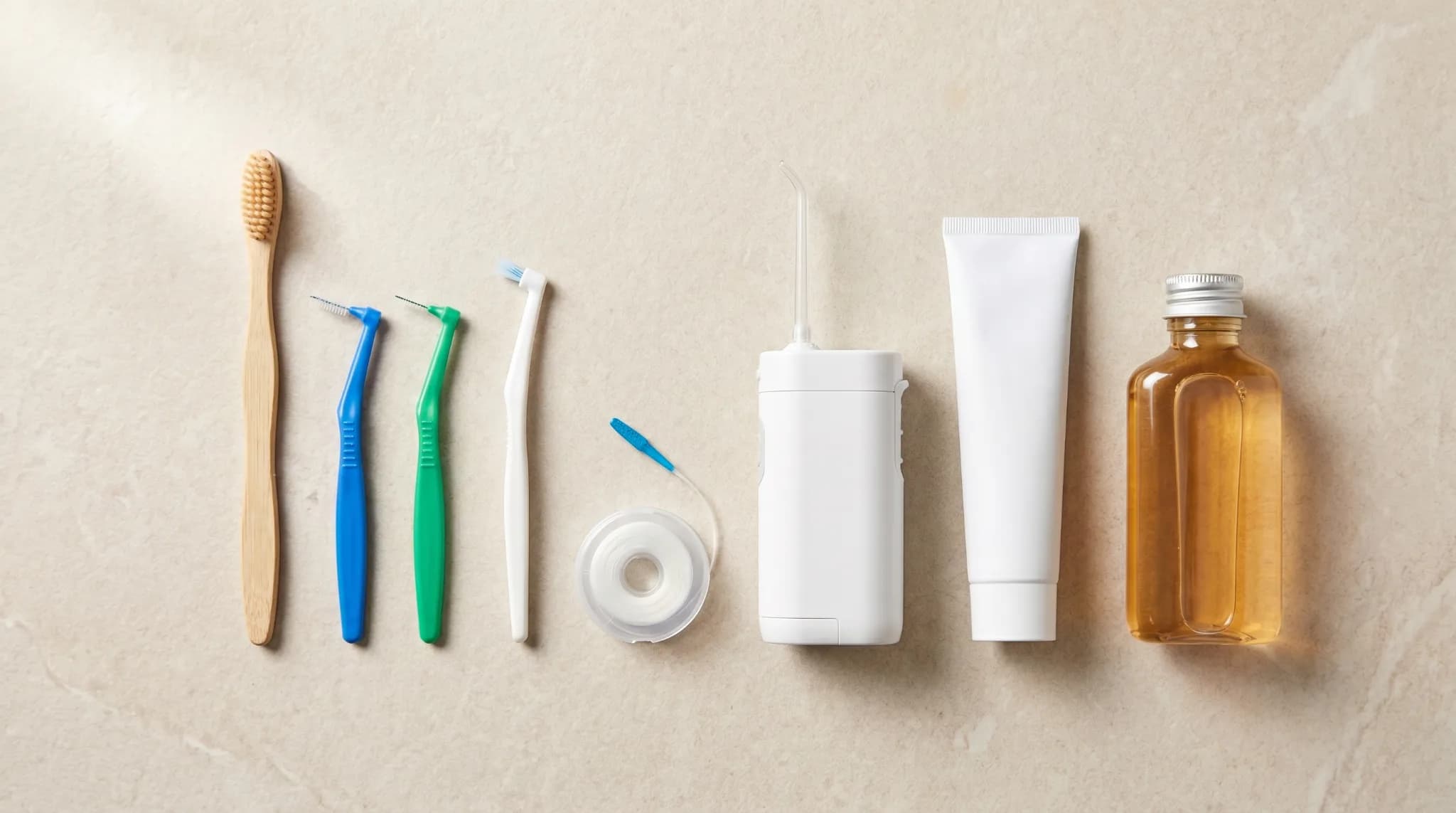
I suggest most patients put together a small hygiene kit to carry with them: a travel toothbrush, a small toothpaste, one or two interdental brushes in a little case, and a piece of orthodontic wax in case something rubs. Everything fits in a bag or backpack and saves a lot of stress during the day.
As for chewing gum and sticky sweets, I know I barely need to say it, but no, neither of them, even when you think they would help with your breath. I wrote a separate guide on what to eat and avoid with braces if you want the full picture.
Signs that something is not right
Your gums and teeth will tell you if something is going wrong, you just need to listen. Some bleeding when you first start brushing with a new appliance is normal, the gums are adjusting to a new situation in the mouth. But if it continues for more than a week or two, that is a clear sign that plaque is sitting too long along the gum line. The answer is usually not less brushing. It is more thorough brushing, with a softer brush and the interdental brush used every day.
Gums that swell and grow over the brackets are a sign of chronic inflammation. Come in straight away and we will sort it out together. Pale patches you notice around the brackets are the early stage of decalcification. We do not have time to waste on that one, the routine needs to change immediately.
Persistent bad breath that does not clear after brushing usually means food is sitting somewhere between the teeth or under the wire where you cannot see it but others can smell it. A more careful pass with the interdental brush, a water flosser, and cleaning your tongue (which many people forget about) usually fixes it.
My rule is simple. If you notice any of these things, do not wait for your next scheduled appointment. Get in touch, come in earlier, and we will fix it. Most of these problems take five minutes to resolve at that stage. If you wait three months, it takes much longer.
What happens after the braces come off?
When I eventually remove your braces, and that is a happy day, I promise, hygiene goes back to something closer to what it was before. You will be left with a thin retainer wire bonded to the inside of your front teeth, which you clean with a regular toothbrush and the interdental brush in passing, and a removable retainer. It is not demanding, but it does need daily attention for life, because it protects everything we built together over those two years.
If you are thinking about a more discreet option and the hygiene demands of fixed braces feel like too much, it is worth looking into clear aligners. Aligners are removed when you eat and brush your teeth, which makes oral hygiene during treatment significantly easier.
To wrap up
I want you to know that none of my patients are perfect, and I was not either when I went through my own treatment. There will be evenings when you really do not want to spend another twenty minutes brushing and you will just grab your regular toothbrush, do a quick pass, and go to bed. That is fine, as long as the full routine is back the next day. Hygiene with braces is not a test you have to score full marks on every single day. It is an average that builds slowly.
If you ever feel lost among all these tools and steps, at every appointment I am happy to go through what is missing and show it to you directly in your own mouth, on your own brackets. That is always clearer than any written guide.
If you have not started treatment yet and you are thinking about it, or if you have questions about what your daily routine would look like with braces, book a consultation and we can sit down and go through everything at a relaxed pace.
Got a question about this topic?
Book a specialist consultation or a free online consultation, I reply the same day.