Why do some people wear braces for 18 months and others for 5 years?
This is one of the questions I hear most often at initial consultations. And I understand why. You see someone who got a perfect smile in a year and a half, and you also know someone who has been dealing with the same braces for four years with no end in sight. It's a logical question: what makes the difference?
I'll tell you straight away, because it matters: the difference rarely lies in the braces. It lies in a combination of different things — your starting situation, how your body responds, what you do during treatment, and how dedicated your orthodontist is. Too often, orthodontic practices operate on a conveyor-belt model that keeps prices low and is appealing to patients.
But on the other side of that coin is a lack of individual attention, which significantly extends treatment — often to five or even seven years. The consequences can be serious, but that's a topic for another article. And while most of these factors are largely out of your hands (except for carefully choosing your orthodontist), the rest are entirely up to you.

How long does braces treatment realistically take?
For most patients, treatment lasts between 12 and 24 months. In more complex cases — where tooth extractions, bite correction, or moving impacted teeth are involved — it can extend to 30 months, rarely more. Any serious orthodontist can confirm this as the standard.
But when a case planned for 18 months ends up taking 36 or 48 months, that's no longer a question of complexity. That's a question of what happened in between.
Factors you can't control:
Before we get to what actually matters, let's clear this part up. Your starting situation, biology, and age are what they are. If you have an impacted canine that needs to be extracted from the bone, that takes as long as it takes. If your bone remodels more slowly — and there are people for whom this is the case — your teeth will move at a slower pace. If you start treatment in your late forties rather than at fifteen, that also plays a role, since younger bone is more adaptable.
Your orthodontist accounts for all of this in the treatment plan from the very first consultations. That's why I give patients a range, not an exact date. You don't need to worry about this part. It's not your responsibility.
But the next part is.
Factors you directly control:
This is where the real differences are made — these are the things that will have the greatest impact on how long you wear braces.
Regular check-ups are non-negotiable
The most common misconception I hear is: "I'll skip one appointment, I'll catch up at the next one." That's not how it works. The wire on your braces is designed to exert a specific force over a specific period of time. Once that time is up, the wire has done its job and simply stops moving your teeth. A patient who misses appointments for several months is essentially wearing a passive appliance. The teeth are still. Treatment is at a standstill.
Studies show something that doesn't surprise me: patients who miss more than two appointments end up finishing treatment almost a full year later than those who come in regularly. That's an entire extra year with braces in your mouth, simply because you didn't show up on time.
Check-ups are usually scheduled every four to six weeks. If something comes up, call and reschedule — but don't just skip it.
A broken bracket wastes weeks, not days
This is one of the most underestimated reasons treatment gets extended. A bracket comes loose, you think: "No big deal, I'll mention it at my appointment in three weeks." But during those three weeks, that tooth had nothing moving it. All the other teeth continued on their own — and that one stopped. When you come in, I have to rebond the bracket and often correct what happened in the meantime.
The rule is simple: brackets only break when the rules aren't followed. And to prevent it from happening as often as possible, it's worth reading, remembering, and following which foods to avoid with braces — it's the most common cause of broken brackets.
Elastic bands — the silent treatment extender
If your treatment plan includes bite correction, you'll receive intermaxillary elastic bands to put on and change at home. That's where the trouble starts. These bands need to be worn for 22 hours a day. They're only removed while eating and brushing.
And what actually happens? The patient wears them at night — not even consistently — feels uncomfortable at school or work, takes them out, forgets to put them back. Then they come in for an appointment, I check the bite and see nothing has shifted. The patient says they wore them. They didn't.
This is probably the biggest invisible treatment extender I encounter. Without disciplined use of the bands, bite correction stalls, and the braces stay in until that part is resolved. If your orthodontist says 22 hours, that means 22 hours. Not when you get around to it.
Poor oral hygiene puts treatment on hold
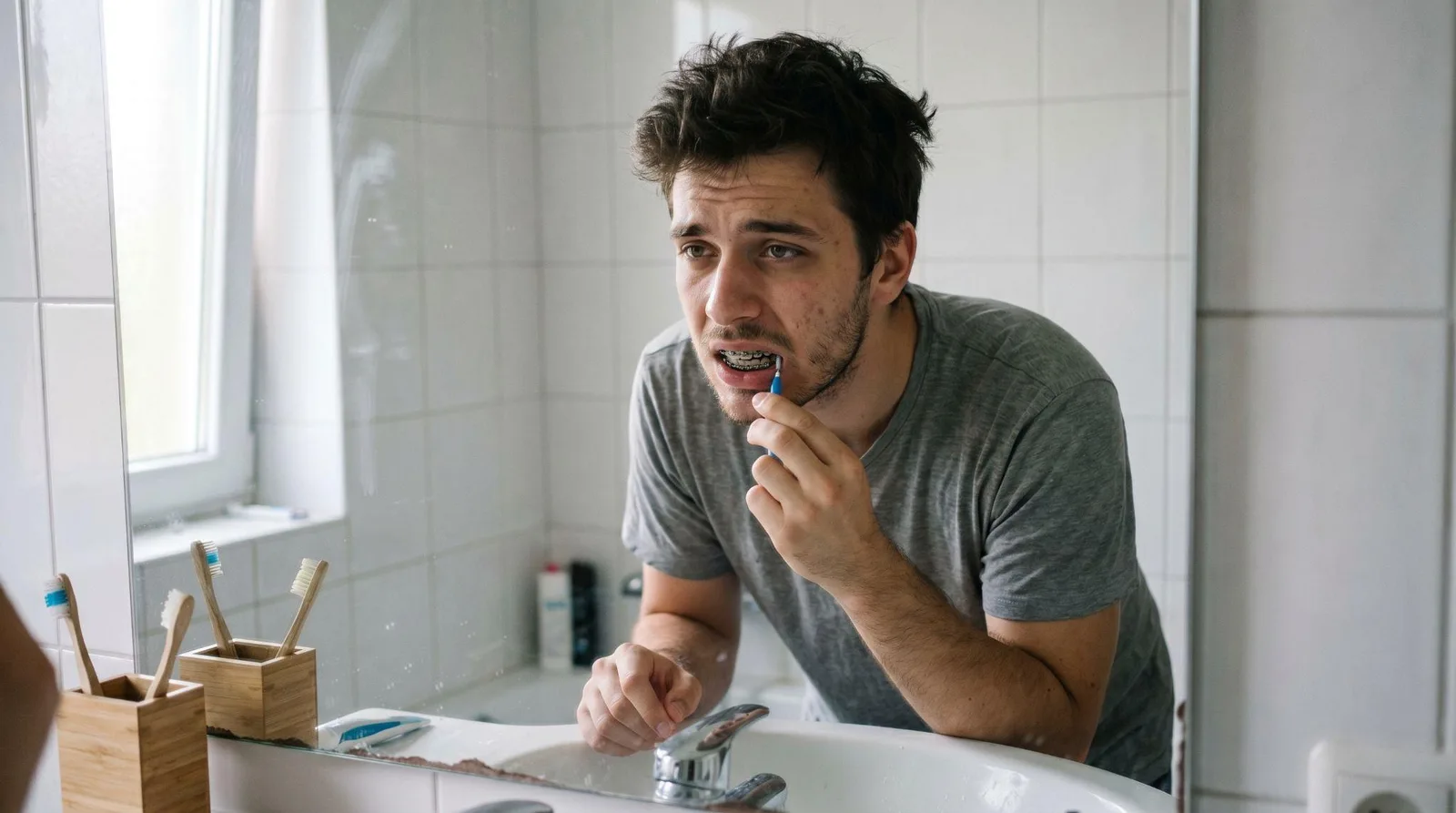
When plaque builds up around the brackets, the gums become inflamed. They turn red, swollen, and bleed on contact. In that state, I cannot continue with active treatment — moving teeth through inflamed tissue is unwise and often not even possible. The patient has to improve their hygiene, wait for the gums to calm down, and only then do we continue.
If this happens once or twice during treatment, we've lost weeks. If it's a recurring problem, we lose months. That's why it's worth learning how to properly maintain oral hygiene with braces — it can genuinely shorten your treatment.
Treatment prep isn't wasted time
Patients sometimes impatiently ask why I don't place the braces immediately if they have untreated cavities or gum issues. Because a cavity under a bracket means I'll need to remove it, treat the tooth, and re-bond — which costs both of us time. Because periodontal disease can progress during treatment and leave you without a tooth I would otherwise be moving.
Healthy teeth before placing braces are a prerequisite, not a suggestion.
Bad habits you don't even notice
Biting your nails, chewing on a pen cap, opening packages with your teeth, crunching ice, eating seeds with the shell on. These are habits people have — often automatic ones — that systematically damage the appliance. Not always dramatically enough to knock a bracket off immediately, but more often in a way that distributes the wire's force unevenly and makes treatment progress less predictably. If you have any of these habits, become aware of them and make an effort to stop. It's not easy, but it pays off.
Retention determines whether it was all worth it
Removing the braces isn't the end. That's when retention begins. You'll receive either a thin wire bonded to the inside of your teeth, removable retainer trays, or both. Those trays need to be worn every night. Not for a month, not for a year — permanently. I know that sounds like a lot, but wearing a retainer tray at night is nothing compared to what you go through during active treatment.
Teeth have a biological tendency to return to their original position. If you don't wear your retainers, they will shift. Slowly in some people, quickly in others. After two or three years you come back to the practice with shifted teeth, and we're looking at starting over with clear aligners — or sometimes a new set of fixed braces. Everything you worked for is gone.
How to avoid unnecessarily extending your own treatment?
Let me sum this up into the things that genuinely matter most. Come to your check-ups on time — and if you need to reschedule, call, but don't skip. Wear your elastic bands exactly as instructed, not less. Maintain thorough hygiene, especially around the brackets, with the right tools. Avoid foods that damage the appliance and habits that are harmful to it even when they seem harmless. And after debonding, wear your retainers every night — for life.
The difference between a patient who does all of this and one who doesn't is the difference between 18 months and four years. That's real.
Got a question about this topic?
Book a specialist consultation or a free online consultation, I reply the same day.