Soft or Hard Toothbrush: How Do You Know Which Is Yours?
If you have ever stood in front of a shelf of toothbrushes and seen three boxes, soft, medium and hard, the same thought probably crossed your mind as it does for most people: a harder one surely cleans better. That very thought is the reason so many patients come to me with receding gums and sensitive teeth. So let me clear up when you actually need soft, when you go even softer, and where a hard brush does have its place, because it does, just not where you would think.
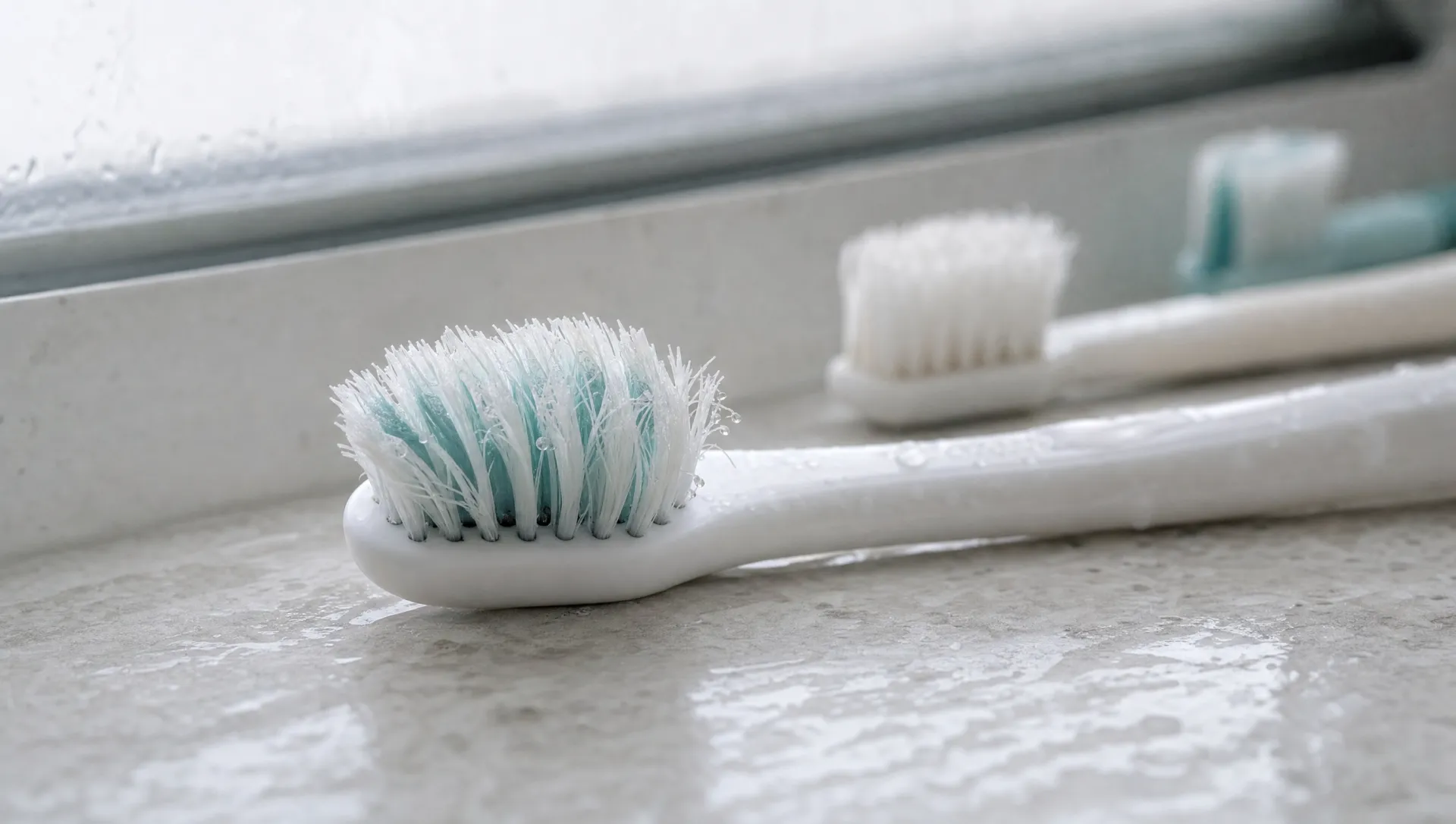
Maybe not the answer you expect…
For your teeth and gums the answer is almost always a soft brush, and for some people even extra-soft. You do not need a hard one, and that is not me being overly cautious, it is simply what we reliably know. The rest of this text explains why that is and how to choose the right one for yourself, because the choice is not the same for everyone.
Why a harder brush does not mean a cleaner one?
This misunderstanding is worth clearing up right away. The plaque you remove every day is a soft, sticky layer, not tartar, and it does not need force to come off. Soft bristles remove it just as well as hard ones, and clinical comparisons back that up.
What actually decides how clean your teeth are is not the stiffness of the bristles, but how long you brush, whether you reach every surface, and at what angle you hold the brush.
Here a soft brush even has the advantage. Because its bristles are flexible, they bend around the curves of the tooth and slip a little under the gumline, exactly where plaque likes to gather. Hard bristles are too rigid for that, so they skip those spots while scraping whatever they do reach.
What a hard brush does over time, without you even feeling it?
The damage from a hard brush is not dramatic like a cut, it is slow and quiet, and that is exactly what makes it sneaky. For years you do not notice it, and then one day you see that your gums have pulled back and a tooth reacts to cold.
Your gums pull back
When you keep dragging hard bristles across the gumline, the thin gum tissue starts to retreat from the tooth. The root gets exposed, and it has no enamel and is far more sensitive than the crown. Once a gum has receded, it does not grow back on its own.
Notches and sensitivity appear on the tooth
At the join between tooth and gum, small wedge-shaped notches form over time, spots where the enamel has simply been scrubbed away. Through them it is easier to reach the dentin underneath, so that unpleasant sensitivity to cold, sweet and even a draft of air shows up. And the thinner the enamel, the yellower the tooth, because more of the dentin shows through.
The real secret is not the stiffness, but the pressure
Now comes the part that changes the whole story. It matters far less how hard the bristles are than how hard you press and how you move the brush. A hard brush in a calm hand does less damage than a soft one you scrub back and forth with all your strength. So instead of choosing a harder brush to clean better, do the opposite: take a soft one and lighten your hand.
A few small things that change everything:
- Hold the brush at about a 45 degree angle to the gumline, not laid flat against the tooth.
- Use short, gentle strokes, no wider than one tooth, instead of long sweeps across the whole jaw.
- Press about as hard as the weight of a single orange. If you hear loud scraping, it is too much.
- Hold the brush with three fingers, like a pen, not in a clenched fist.
So how do you choose the one that is yours?
For most healthy mouths a soft brush is the beginning and end of the story. But there are situations where you go even softer, and that is important to know, because people instinctively reach for a harder brush then, thinking troubled gums need stronger scrubbing. The truth is the opposite. Here is how it looks in practice.
| Your situation | Which brush | Why |
|---|---|---|
| Healthy gums and teeth | Soft | Removes plaque without harm, enough for everyday care |
| Sensitive teeth or receding gums | Extra-soft | Cleans gently where the tissue is already vulnerable |
| After gum surgery or periodontal therapy | Extra-soft, as advised | Does not irritate freshly healed tissue |
| A child | A children's soft brush, small head | Suited to little teeth and tender gums |
| Fixed braces on the teeth | Soft or orthodontic | Cleans around the brackets without hurting the gums |
| Denture, aligners or a night guard (out of the mouth) | Hard or a dedicated denture brush | Cleans acrylic and plastic with no risk to the gums |
Where a hard brush really does come in handy?
So the hard brush is not the enemy, it just has a perfect role, only not in your mouth. For cleaning dentures, retention aligners, night guards and similar things that come out, firmer bristles are exactly right, because there are no gums to injure there. The one thing worth knowing is that for dentures it is smarter to use a dedicated denture brush, which is firm but made so it does not scratch the acrylic, since a scratched denture collects deposits more easily.
If you wear fixed braces, well…
With fixed braces the rule is even clearer. The gums around the brackets are already under more strain and get irritated more easily, so a hard brush is the last thing you need. A soft brush, with bristles that can get around the brackets and under the wire, does a far better and safer job. I wrote about brushing technique with braces in more detail in a separate article.
How do you tell you are already pressing too hard?
This may be the most useful part, because many of us brush too hard for years without even suspecting it. A few signs give you away:
- The bristles splay and bend out of shape within a couple of weeks. A brush should last about three months, so if you replace it much sooner because it is worn out, your hand is too heavy.
- You see that your gums have receded and your teeth look longer than before.
- Along the gumline you notice small notches or grooves.
- Your teeth react to cold and sweet, and your dentist has found neither a cavity nor gum disease.
If you recognise any of this, you do not need a different toothpaste or a stiffer brush, just a lighter hand. And it is worth mentioning at your next check-up.
The whole thing fits into one sentence: you do not clean teeth with force, but with patience and technique. A soft brush in a relaxed hand beats a hard one every time, protects your gums and enamel in the long run, and does exactly what you picked up the brush for. And if you are ever unsure which one is yours, bring the brush you use now to your appointment. It often tells me more than words do.
Got a question about this topic?
Book a specialist consultation or a free online consultation, I reply the same day.