Retainers After Braces: Why You Wear Them for Life, and What Happens If You Don't

Patients remember the day their braces come off. The brackets are gone in about half an hour, for the first time in two years the tongue slides over smooth teeth, and the mirror shows the smile we worked on throughout the whole fixed braces treatment, one check-up after another.
On that day I usually say one sentence that slightly spoils the celebration: from today, the most important part of the job is yours.
A retainer, or retention, as we call it in orthodontics, is worn for life. It can be a thin wire bonded to the inside of the teeth, a clear aligner you put in and take out, or both. What suits whom is something I decide and recommend at the end of treatment, and that is my part. Your part is to follow that plan, for the rest of your life.
Why don't teeth stay where we put them?
When the braces come off, teeth cannot stay in their new position permanently on their own. They have a natural tendency to move back towards where they started. That does not mean the treatment failed. It is simply how nature works: nothing in the face is static, and neither are the teeth.
Nothing in the body stands still. The face changes with age, muscles weaken, wrinkles deepen, and all of it needs some kind of upkeep. There is no reason to expect that teeth, somehow, will look after themselves.
In people who stop wearing their retainer I always see the same thing: the teeth move back. Sometimes almost to where they were before treatment, sometimes less, but the result is always worse than the one we finished with. Orthodontists call this relapse. Patients put it more simply: my teeth went back.
Wire, aligner or both
The wire is thin and rounded, bonded to the inside of the front teeth, and it does not come out. It cannot be seen from the outside, and the tongue only notices it for the first few days, after which it gets used to it and the wire stops bothering it.
The aligner is clear, made to fit your teeth, and you put it in and take it out yourself. For the first three months it is worn almost all day, and after that only at night. It also protects the teeth from grinding in your sleep, which many people do without even knowing it.
Which retainer you get depends on how the teeth were positioned at the start, how severe the problem was, genetics, habits and lifestyle. For some people an aligner is enough, others need a wire, some need both. That is why I make a retention plan for every patient individually, at the end of treatment, when I can see exactly what we have achieved, what the starting point was, what will matter from now on and how best to protect the result.
Excuses I hear in the clinic
Most of what I know about retention I learned from patients who stopped wearing it. When they sit in the chair with teeth that have started to move back, the stories are almost always the same. None of them is silly and none of them is rare, which is exactly why they are worth telling.
A trip without the aligner
You pack for the seaside and the aligner stays behind in the bathroom. A few days won't matter, you think. When you get back, the aligner no longer fits. The teeth have moved in the meantime, and the aligner was made for the teeth as they were before the trip.
So the aligner goes into the suitcase before the toothbrush does. And if you do forget it, get in touch as soon as you are back, and don't wait to see whether the teeth will move back into place by themselves.

A few days of illness, and the habit is gone
Flu, a temperature, nights when you can't be bothered with anything, least of all the aligner. That is understandable. The problem comes later, when you are better and the aligner stays in its case because you have lost the habit. A habit built over months disappears in a week, and the teeth do not wait for your motivation to come back.
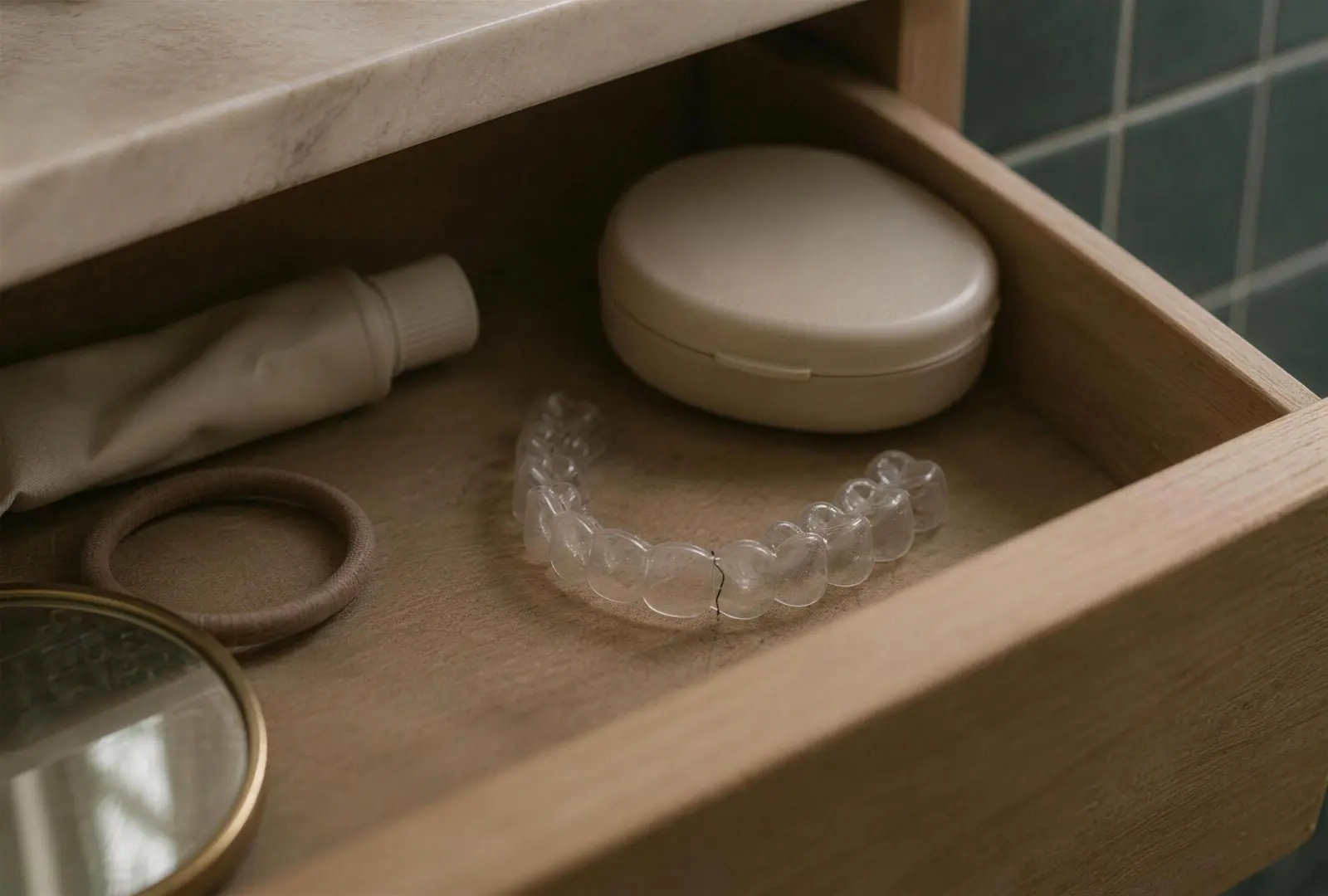
A broken aligner in the drawer
The aligner cracks, you put it in a drawer and promise yourself you will drop by for a new one. A month goes by, then two. A broken aligner does not hold the teeth, so it is the same as not having one at all. More on that a little further down.
My friend doesn't wear one and nothing happened
And then there is the classic: a friend has not worn their aligner for ages and nothing has happened to their teeth. Maybe that is true. But their teeth, their treatment and their starting point are not yours. In some people the change shows faster, in others slower, and nobody can promise you in advance that you will be the lucky one.
I don't say it to scold anyone. The decision is yours, and my job is to make sure you know what you are choosing. How long treatment takes and what it depends on, I explained in the article on why some people wear braces for 18 months and others for five years.
The wire came loose or the aligner cracked: now what?
Any retainer can be physically damaged. The wire can come off one tooth or snap, the aligner can crack or break. Whatever happens, the rule is the same: a damaged retainer does not do its job. Get in touch and we will make a new one.
It matters that you don't wait. When the wire comes off a tooth, nothing holds that tooth any more, and a broken aligner holds none of them. Every day without a working retainer is a day in which the teeth can start moving back, and the longer you wait, the less there is left for the new wire or aligner to protect. You can book an appointment online.
How to make the wire and the aligner last
With the wire, the most common mistake, strange as it sounds, is being too careful. Patients are afraid of damaging it, so they don't clean properly around it. Yet tartar builds up most easily right around the wire. That is why a bonded retainer needs two things: thorough brushing around the wire itself and regular professional scaling. The wire is strong enough for a toothbrush and an interdental brush, so there is no need to be afraid of it.
With the aligner the mistake is the opposite: too much force. Many people take it out and put it in by pulling on one side, so the aligner goes in at an angle. The aligner is deliberately rigid, because that is the only way it can hold the teeth in the right position. That rigidity also means it does not bend, so this kind of handling makes it crack or break. Take it out and put it in evenly, on both sides, the way I show you when you collect it.
Handled properly, an aligner has no expiry date. Most patients still replace it after a few years, not because it stopped working, but because it has changed colour.
When the teeth have already moved back
It happens, and you are not the only one. People come to our clinic in Novi Sad whose teeth moved after treatment, sometimes soon after the braces came off, sometimes many years later. Some of them wore their braces with another orthodontist.
What comes next depends on two things: how much time has passed and how much the teeth have moved. When the bite is still correct and the shift is small, I usually suggest clear aligners. They are more comfortable than fixed braces, and people who have already worn brackets once usually accept them more easily. When the shift is bigger, we look for the solution together, at a consultation.
After that, of course, comes retention again. This time for life, and for real.
How much does a retainer cost?
Retention is paid for separately and is not part of the treatment price. Clear retainers cost €100 (12,000 RSD) per jaw, and a bonded wire retainer €150 (18,000 RSD) per jaw. All prices are on the price list.
Compared with what went into the treatment, in money and in two years of check-ups, it is a small amount. And it is what protects everything else.
The smile in the mirror on the day the braces came off is yours. A retainer is simply the way to keep it like that twenty years from now. If you think your teeth have moved, or your wire or aligner is damaged, book a consultation while the shift is still small.
Got a question about this topic?
Book a specialist consultation or write to me, I reply the same day.