What Are the Parts of Fixed Braces?
Patients ask me all the time, while I sit beside them fitting the appliance, what everything is that goes into their mouths. Completely fair question. Fixed braces are not one piece of metal — they are a small system of about ten different components, each with its own role, all working together to bring your teeth into the right position.
Before we go through them one by one, I want to clear up something I run into every single day. In everyday speech, people almost always call this a "fixed denture". That is incorrect. A denture replaces a tooth that no longer exists — for example, when someone needs an artificial tooth. What we are talking about here is a fixed brace or fixed orthodontic appliance.
I joke with patients that this is probably the most persistent term that refuses to disappear from everyday language, but once you have read what makes up a fixed brace, you will understand exactly why the distinction between a denture and a brace genuinely matters.
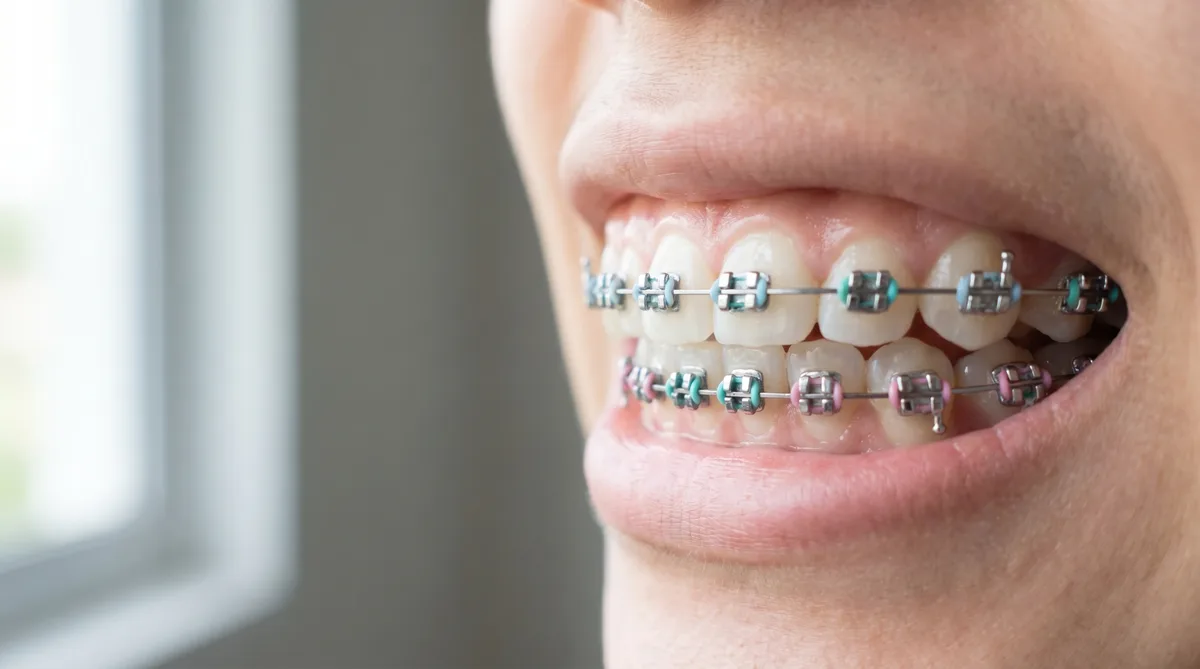
Passive and active components
Everything you see falls into two groups. Passive components are the ones bonded to the teeth or wrapping around the tooth — they do nothing on their own; they are there to transmit force. Active components carry that force, pushing, pulling, or rotating teeth into the desired position. The combination of the two makes treatment possible. Without active components nothing moves, and without passive ones there is nothing to apply movement to.
Brackets
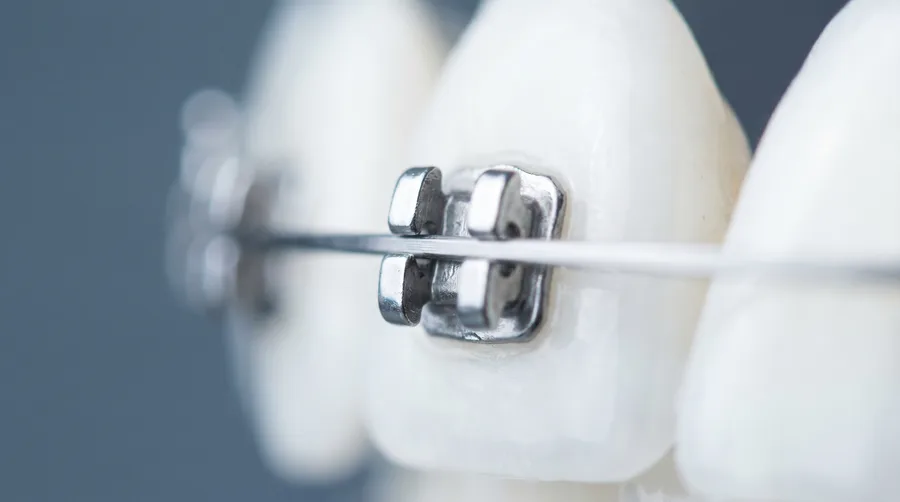
Brackets are small metal or ceramic elements, smaller than a grain of rice, bonded with a special adhesive to the center of the front (or, in the lingual variant, the back) surface of each tooth. This is the fundamental passive component. Each bracket has a central groove called the slot, through which the wire passes, and four small wings around the slot to which elastics or wire ligatures are attached. The position of the bracket on the tooth is not arbitrary — I place it precisely because it dictates the direction in which the tooth will move. That is why, if a bracket happens to come off, we put it back in exactly the same spot.
Metal brackets
The classic, stainless steel variety — the most widely used. They are the most precise in transmitting force and the most affordable. Their only drawback is aesthetic: they are visible when you smile.
Ceramic and sapphire brackets
The aesthetic alternative. Ceramic brackets match the color of the tooth and blend with the enamel; sapphire brackets are transparent and practically disappear on the tooth. They work on exactly the same principle as metal brackets — force is transmitted identically. Some older ceramic systems had a problem with wearing the enamel of the opposing tooth, but that is not an issue with the modern brackets we use.
The archwire
If brackets are the passive component, the archwire is the main active one. It is a thin wire that runs through the slot of every bracket and connects them all in a continuous sequence. The wire is manufactured in the shape of an ideal dental arch, and when I bend it to fit into your misaligned brackets, it constantly tries to return to its original shape. That recovery pulls the teeth along with it. This is the principle of shape memory.
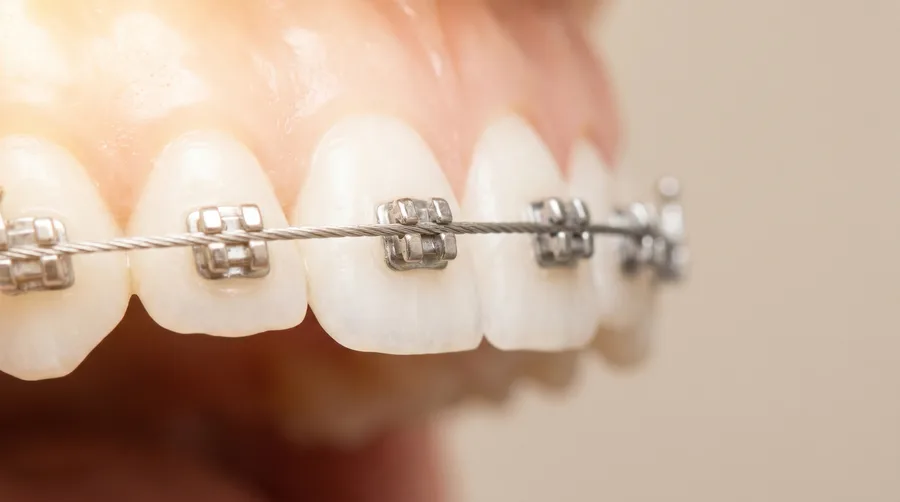
Over the course of treatment I change your wire several times. At the beginning I use a thin nickel-titanium wire that is highly flexible and gentle — ideal for the first, largest movements when the teeth are still severely misaligned. As treatment progresses I move to thicker, stiffer wires. Beta-titanium wires offer a middle balance of strength and flexibility, while steel wires are used in the final phases when precise, strong work on the root position is needed. This sequence of wire changes is why every appointment matters and why treatment cannot be accelerated by skipping steps.
Tubes and bands on the molars
On the last permanent molars — usually the first molars — a regular bracket is rarely used. These teeth are the anchor of the whole system; the wire ends on them and the greatest forces pass through them. For this reason I use tubes on these teeth: small metal cylinders through which the wire slides in and out. Tubes are bonded directly to the tooth.
In some cases, if the tooth is heavily restored or I need an especially strong anchor, I use an orthodontic band that wraps completely around the tooth instead. The band has a tube welded onto it and provides the strongest possible attachment, but it requires a small gap to be created between the teeth beforehand — achieved with separators, which I will come to shortly.
Ligatures
With conventional brackets the wire has to be held in the slot somehow. That is the job of ligatures.
Elastic ligatures
Small colored elastics slipped around the wings of the bracket to hold the wire in the slot. They are replaced at every appointment because they gradually lose their elasticity. This is where the part of treatment that children love begins — choosing colors. Team colors, the Serbian flag, anything goes. Adults usually choose neutral, grey tones that attract as little attention as possible.
Wire ligatures
Thin stainless steel wires twisted by hand around the bracket, holding the wire more securely than elastic ligatures. They are used in specific phases when greater stability is needed or when elastics cannot keep the wire under stronger forces.
Power chain
A series of connected elastic rings that simultaneously hold the wire and link several brackets together. When I want to close a gap or bring two teeth closer, the power chain does this by applying a constant gentle pull. It loses strength over time and is replaced at appointments, and it is important that it remains under the orthodontist's supervision, as unwanted tooth movement can otherwise occur. It comes in colors as well, so there is room for some creativity there too.
Auxiliary components that make a big difference
Springs
Small metal coils placed on the wire between two brackets. An open coil spring is already in a stretched state, constantly pushing to return to its resting size, thereby separating two teeth and opening space — for example, when room is needed for a tooth that has erupted out of alignment. A closed coil spring does the opposite: it is in a compressed state and constantly tries to shorten, pulling two teeth toward each other and closing a gap.
Hooks
Small metal projections on certain brackets and tubes, designed specifically so you can attach something to them — most often the intermaxillary elastics described below.
Stops
Tiny metal beads crimped onto the wire on either side of a bracket. They keep the wire exactly in position so it cannot slide forward or backward through the slot. Used when precise control of the wire's position is required.
Intermaxillary elastics
These are the elastics I give you in a small bag for you to change at home yourself. You hook them onto the hooks — one end onto a bracket on the upper jaw, the other end onto a bracket on the lower jaw. They pull the upper and lower jaws toward each other and are used when the bite needs correcting, most often when the upper and lower teeth do not meet correctly. Your cooperation here is absolutely essential: I cannot wear them for you, and without them this phase of treatment simply does not progress.
Bite turbos and bite blocks
Small raised areas made of composite material placed on the inner surface of the upper front teeth or on the biting surface of the molars. When you close your mouth you cannot fully contact the other teeth. They are used in cases of deep bite to open the vertical space and to prevent the lower brackets from striking the upper teeth during closure. They are temporary and are removed once they are no longer needed.
Separators
Before I place a band around a molar, I need a small amount of space between the teeth. I insert tiny rubber rings that create just enough of a gap over several days. Separators are only in place for a short time — usually seven to ten days — and patients feel them as a mild pressure between the teeth.
Mini-implants and special elements
In complex cases where a very strong anchor is needed — one that must not yield under any circumstances — I use mini-implants, known as TADs (temporary anchorage devices). These are tiny titanium screws placed into the jawbone under local anesthesia and serve as a fixed point from which to push or pull specific teeth. They are not used for every patient, only when the anatomy of the case requires it.
Lingual buttons are small attachments I occasionally bond to the inner surface of a tooth when a specific movement is needed — usually a rotation — that cannot be achieved through the outer bracket alone.
What is not part of the brace, even though people often think it is?
The orthodontic wax I give you in a small box is not part of the appliance — it is there to help you through the first few days until the lining of your cheeks and lips adjusts to the brackets. Press it onto a bracket that is irritating you and replace it as needed.
The retainer is not part of the fixed brace. It comes after the braces are removed, when treatment essentially enters the phase of maintaining what has been achieved. That is a separate story for another article.
Interdental brushes and other hygiene aids are not part of the brace — they are your orthodontic allies. I write more about them in the article on how to clean your teeth properly with braces. It is also worth mentioning that certain foods can damage the smaller components — the power chain, springs, and elastics — so it is worth reading about what to avoid in your diet as well.
Why is it useful to know the name of each part?
The most practical reason is that you will be able to describe what happened when you call me about something. Has a bracket come off (passive component — needs rebonding), has the wire come out of the tube (needs repositioning), has the power chain broken (will be replaced at the next appointment), has an elastic gone missing (usually nothing urgent), or has a spring broken (better to book an earlier slot)? Each of these situations has a different level of urgency and a different response. When I know exactly what we are dealing with before you sit down in the chair, we both save time.
And one more thing. Now that you know that a fixed brace is not a single piece but a system of about ten different small components working together, it is also clear why the word "denture" simply does not apply. A denture is a finished object that replaces something that is missing. A brace is a system of tools that actively works on what you already have.
If you are thinking about straightening your teeth and are not sure whether a classic fixed brace with all of these components or a more discreet option like clear aligners would suit you better, book a consultation and we will assess your case together and choose what makes sense for you specifically.
Got a question about this topic?
Book a specialist consultation or a free online consultation, I reply the same day.