A Gap Between the Front Teeth: Why I Close It Instead of Filling It

The rest of your teeth are nice and straight, but there is a gap between the two upper front teeth that shows in every photo. The question people with that gap ask most often sounds simple: should I fill it or close it?
A gap between the front teeth is called a diastema, and it is most often between the two upper central incisors. In a child, the gap is assessed only once the permanent canines come in, between the ages of 9 and 13. In an adult, the gap is not just a space between two teeth but part of the bite, so I close it by moving the teeth. Veneers are faster, but keeping your natural teeth comes first, and veneers can only be considered when the bite is ideal. And one more thing that is rarely said: a gap has a strong tendency to return to how it was, so retention always follows closure, often different from retention after other problems.
With children, we wait for the canines
If your child has a gap between the upper front teeth, it does not have to be a problem. Gaps in children are often part of the change from baby to permanent teeth, which I wrote more about in the article on crooked teeth in children.
What parents want to know is how long to wait. My answer is: until the permanent canines. Once they come in, usually between the ages of 9 and 13, the picture is complete and only then does it make sense to assess the gap. If the gap is still there after that, it is time for a check-up.
Does the lip frenulum have to be cut?
Some websites say that the frenulum, the small fold of tissue that connects the upper lip to the gum between the front teeth, must be removed to close the gap. Not always.
The frenulum is sometimes the cause of the gap, but that is determined at an examination, not in the mirror or from a photo. If it is the cause, it is removed, and that small procedure is called a frenectomy. When it is needed, it is done before orthodontic treatment begins. If the frenulum is not the cause, there is no reason to touch it.
Just a small gap?
Adults often come in saying: it is just the gap, the rest of my teeth are fine. It only sounds like a small problem, and it is not one at all.
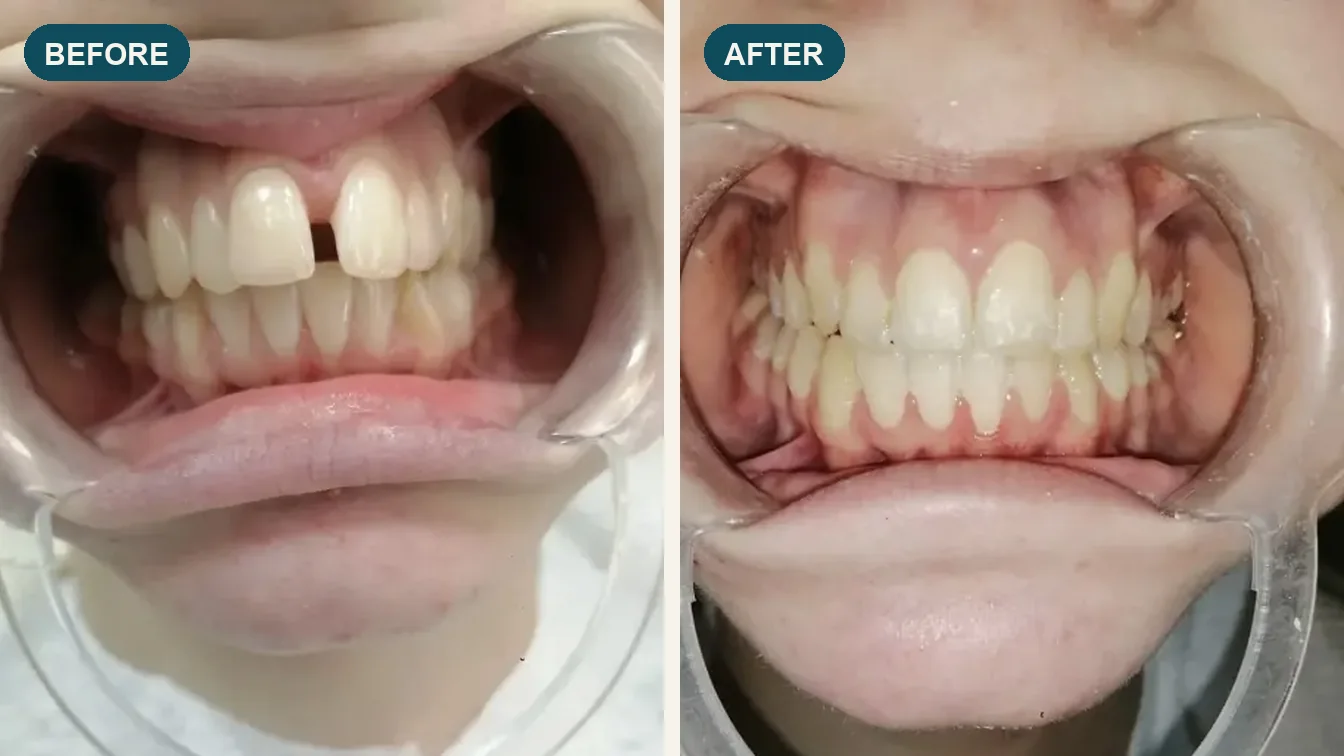
The upper front teeth do not stand on their own. Together with the other teeth they form a bite that is unique to every person. When I close a gap, I move teeth, and as soon as I move teeth, I change the bite. That is why a gap is not closed by simply pulling two teeth toward each other. The whole bite is planned, and at the end of treatment everything has to be in harmony: the gap closed and the bite as it should be.
Teeth are moved with clear aligners or fixed braces. Which option is right for you and how long it will take depends on exactly that bite, and I can only see it at an examination.
Veneers are faster, so why not?
I hear this question often. Honestly: veneers are faster, but they are not better.
A veneer is a thin shell bonded only to the outer surface of the tooth. When a gap is filled with veneers, the teeth stay where they were, and so does the bite. If the bite and the pressure of chewing are not right, that thin shell cannot withstand it, and the veneers start to crack and chip.
Veneers are a good solution when someone has an ideal bite, because only then are they indicated. That is why my order is always the same: healthy teeth and a correct bite first, and only then aesthetics. Read more about how I see a smile, and when veneers do have their place, on the Natural Hollywood smile page.
A gap that was not there before
Sometimes someone comes in whose gap appeared only in adulthood, after years without it. A gap like that does not appear for no reason. Usually some changes happened before it that led to it.
I usually get to the answer quickly, already in conversation. And that is the first step: until we know what opened the gap, there is no point in talking about how to close it.
Gaps like to come back
Every orthodontic problem tends to return to its original state. This is called relapse. With a gap between the front teeth, that tendency is especially strong.
That is why I am very careful about retention after closing a gap. There is no template I give everyone. I do not treat by templates or protocols, I make a retention plan for each patient. What a retainer is, why it is worn for life and what happens when it is not, I wrote about in Retainers After Braces.
And if the gap is your trademark?
Some people say the gap is part of their smile and they do not want it touched. That is completely fine, and the decision is yours alone.
From my practice I can only tell you this: so far I have not had anyone who in the end wanted to keep the gap. Some said at the start that it was their trademark, but once they saw all their other teeth straight, they wanted to fix that too.
The price is not set per gap but by the treatment that is needed, and guide prices for braces and aligners are on the pricing page. If you want to know what is behind your gap, or your child's, you can book a check-up online at my practice in Novi Sad.
Got a question about this topic?
Book a specialist consultation or write to me, I reply the same day.